The Perc Test You're Asking About in Dahlonega Doesn't Exist Anymore
September 24, 2026
September 24, 2026
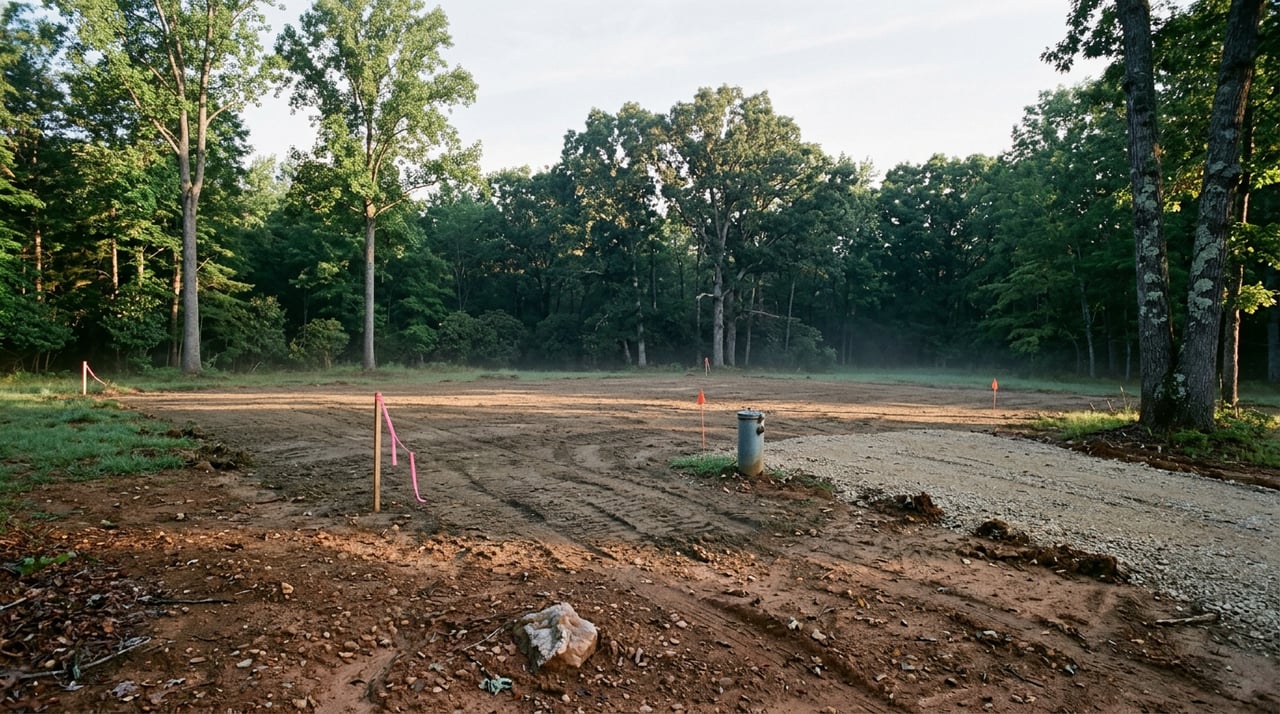
A buyer walks a 4-acre lot off one of the gravel spurs outside downtown Dahlonega, loves the creek frontage and the long mountain view, and asks the listing agent the question every land buyer asks: has this passed a perc test? The answer they get back, whatever it is, is answering a question Georgia stopped asking years ago.
The percolation test, the old method of pouring water into a hole and timing how fast it drains, has been retired by the state. Georgia's public health guidance is blunt about it: the perc test is "an old-fashioned method" and "this outdated method is no longer used." What replaced it is a Level 3 Soil Survey, performed by a state-certified soil classifier or soil scientist, and it is not a formality. It is the document that determines whether the lot you are looking at can legally hold a house at all.
That terminology gap sounds small. On a Lumpkin County land purchase, it is the difference between a closing that happens on schedule and one that stalls while a buyer tries to produce paperwork nobody told them they needed.
A Level 3 Soil Survey classifies the soil under a specific USDA series, maps site features like springs, wells, and rock outcrops, and hands the county a report that either clears a lot for a conventional septic system or forces a conversation about engineered alternatives. It is required before Lumpkin County's Environmental Health office, which operates as the local arm of the Georgia Department of Public Health, will issue a septic construction permit. No survey, no permit. No permit, no certificate of occupancy, regardless of how good the builder's schedule looks on paper.
The survey itself typically takes two to three weeks to schedule and complete on a Lumpkin County parcel, and firms that specialize in this work can sometimes turn a report around by the next business day on lots under three acres once the fieldwork is finished. That is fast, but only if a buyer orders it during due diligence instead of after closing, when the clock is now attached to a mortgage.
None of this shows up on a listing photo. A creek, a view, and a cleared pad look the same whether the soil underneath will pass or fail.
Search "land for sale Dahlonega" and the results blur two products that have almost nothing in common once you get past the acreage number.
| In-town, utility-served lots | Mountain acreage, well and septic | |
|---|---|---|
| Example developments | Summit Drive lots, The Overlook | Norton Ridge, Mount Mincie, Achasta's Bear Paw Ridge release |
| Utilities | Water, sewer, and in some cases natural gas already at the lot line | None. Buyer drills a well and installs a septic system |
| Soil survey required | No | Yes, before any septic permit is issued |
| Typical setting | Gated, wide streets, swim and tennis amenities, minutes from the Square | Estate-sized tracts, 3 to 7 acres or more, long mountain views |
The Overlook and the Summit Drive lots sit inside city limits with underground utilities already run. A buyer there skips the soil survey conversation entirely because there is no septic system to permit.
Drive fifteen minutes out and the product changes completely. Mount Mincie's estate lots run 3 to 4.6 acres with light covenants and no restriction on short-term rentals, which makes them attractive to buyers thinking about a family compound or an investment property, but every one of those lots depends on a well and an on-site septic system that has to clear the soil survey first. Achasta's Bear Paw Ridge release, the golf community's first new home-site offering in fifteen years, sits at the top of the ridge with views of the Jack Nicklaus Signature Golf Course, and it carries the same requirement. Norton Ridge, closer to GA 400 and marketed on its proximity to local vineyards and rivers, is the same story again.
The county-wide land data reflects this split without explaining it. As of this fall, active Lumpkin County land listings average roughly 58 acres in size at an average price near $1.9 million, a number that only makes sense once you realize it is being pulled upward by exactly the kind of large, off-grid mountain tracts described above. A buyer comparing that figure to a 1-acre in-town lot with sewer already run is comparing two different categories of real estate that happen to share a county line.
Lumpkin County issues its own Land Use Permit, separate from the state's septic paperwork, and that permit is only valid for a maximum of six months. For a buyer building on raw acreage, that permit and the soil survey are running on parallel tracks, and both feed into whether a builder can actually start.
Here is where the sequencing mistake happens. A buyer orders survey work, lines up financing, and gets the Land Use Permit issued early because it felt like progress. Then the soil survey takes three weeks longer than expected because of weather or a scheduling backlog, the well driller has a two-month wait list, and the six-month window is half gone before a shovel touches dirt. If the property also disturbs more than an acre or falls within 200 feet of state waters, the county requires an approved Soil and Erosion Plan on top of everything else, which adds another step to the same clock.
None of these deadlines are secret. They are published on the county's own site. What is easy to miss is that they do not run independently of each other. The permit clock starts the day it is issued, not the day the soil survey clears, and a buyer who gets the order backward can watch a six-month window shrink to two months of usable time.
Does a Level 3 Soil Survey apply everywhere in Georgia, or just Lumpkin County? The requirement is statewide. Georgia's Department of Public Health governs septic permitting through its Manual for On-Site Sewage Management Systems, and county environmental health offices, including Lumpkin County's, administer it locally. The perc test terminology is retired across the state, not just here.
How much should I budget for a septic system on a mountain lot? National cost guides for raw land put basic conventional systems in the $3,500 to $12,000 range, with steeper, rockier terrain, common on North Georgia mountain lots, pushing costs toward the higher end or into engineered systems if the soil survey comes back unfavorable. Get a firm quote after the survey, not before.
What happens if my Land Use Permit expires before I break ground? The permit has to be reapplied for, which means resubmitting the paperwork and potentially waiting through the same review process again. Building the survey and well timeline backward from the permit issue date, rather than forward from when you feel ready to apply, is the difference between one application and two.
Land in Lumpkin County rewards patience more than it rewards speed. The buyers who get the sequence right are the ones who ask the soil question before they fall in love with the view.
If you are comparing a Dahlonega mountain lot to an in-town parcel with utilities already run, or you just want someone who has spent time in both worlds to walk the sequence with you, Michelle Sparks can help you sort out which category your target property actually falls into before you write an offer. Get an Instant Home Valuation to start the conversation.


With extensive knowledge of the Lake Lanier real estate market, Michelle helps her clients find their dream lakefront home or successfully sell their property for top dollar.

MICHELLE SPARKS
434 Green St Gainesville GA 30501